Ordinary Diode
Aim
To study the I-V Characteristics of an Ordinary Diode.
Apparatus
- P-N Junction Diode
- Battery
- Connecting Wires
- Resistances
- Voltmeter
- Ammeter
Theory
A P-N junction is formed by doping the P-type with trivalent impurities, which have excess holes, and the N-type with pentavalent impurities, which have excess electrons.
-
Forward Bias:
A positive voltage on the P-type reduces the potential barrier, allowing current to flow. -
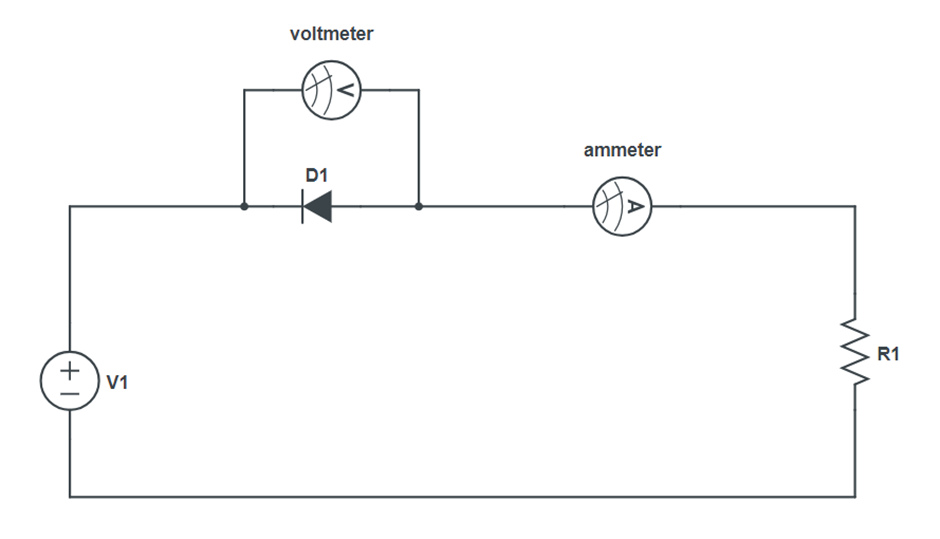
Reverse Bias:
A negative voltage on the P-type blocks current, widening the depletion region.
The junction's behavior depends on the type of impurities and the bias applied. In forward bias, there is a reduction in the potential barrier.
Cathode and Anode:
-
Anode:
The positive terminal, connected to the P-type semiconductor. -
Cathode:
The negative terminal, connected to the N-type semiconductor. - Most diodes have a band or line marking on the cathode end, usually silver or white, distinguishing the negative side of the diode.
- The end without the line is the anode (positive) end.
Circuits
Forward Bias:
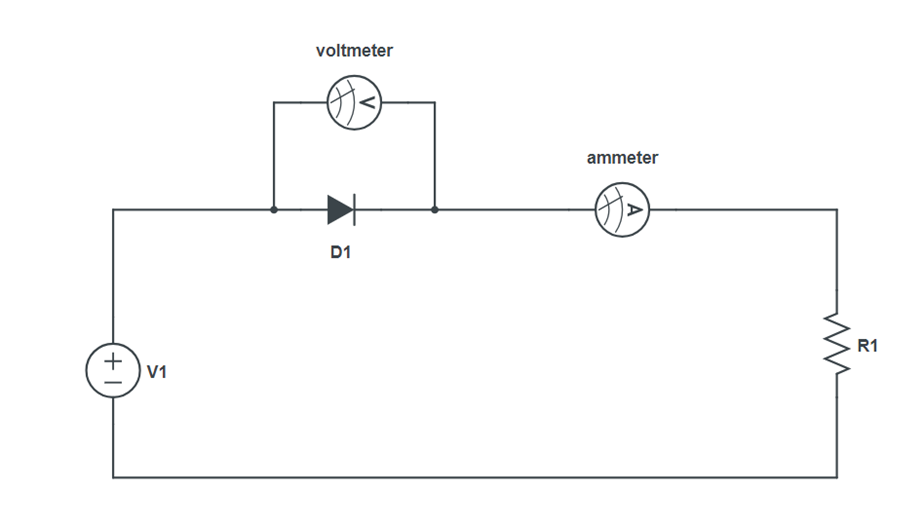
Reverse Bias:
Graph

Result
The V-I Characteristic Graphs/Curves of P-N Junction Diodes (both in reverse and forward biases) are obtained and verified with their proven results.