Multimeter
Analog meters require no power supply, they give a better visual indication of changes and suffer less from electric noise and isolation problems. These meters are simple and inexpensive.
Digital meters, on the other hand, offer high accuracy, have a high input impedance and are smaller in size. They gives an unambiguous reading at greater viewing distances. The output available is electrical (for interfacing with external equipment), in addition to a visual readout.
What is a Multimeter?
A Multimeter, also known as Multi tester, is an electronic measuring instrument which can measure Voltage, Current and Resistance. Hence, the name “Multi” meter, as it combines the functionalities of Voltmeter, Ammeter and Ohmmeter into a single device.
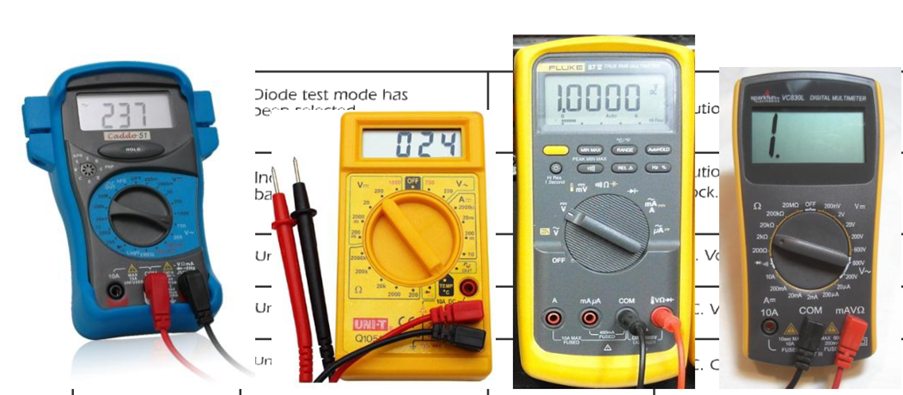
Parts of a Multimeter
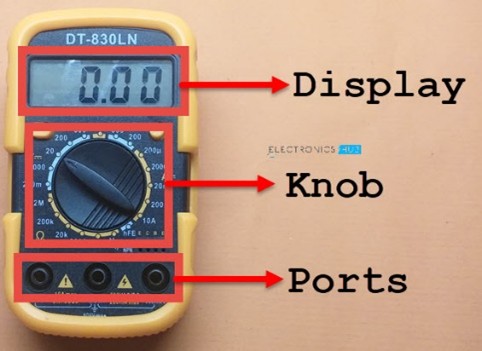
A basic Multimeter consists of four parts. They are:
- Display
- Selection Knob
- Ports
- Probes
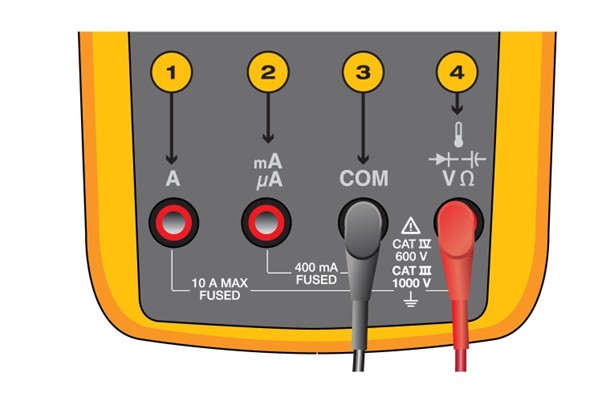
-
A (amps)
Red test lead input for:- Current measurements of up to 10 A.
- Current measurements of frequency and duty cycle.
- Optional mA output current clamp for current measurements of 400 A or more, up to the limit of the clamp.
-
mA, μA (milliamps, microamps)
Red test lead input for:- Current measurements of 0 μA to 400 mA (up to 600 mA for 18 hours).
- Current measurements of frequency and duty cycle.
- Optional mA output current clamp for measurements of up to 600 A ac.
-
COM
Black test lead input for:- All measurements.
- Low/negative connection for circuit measurements or accessories.
- Alternatively known as “return terminal.” COM is short for common.
-
Voltage (V), resistance (Ω), diode test (arrow plus symbol), capacitance (other symbol), temperature
Red test lead input for:- Measurements for voltage, resistance, diode, capacitance, frequency, duty cycle and, if available, temperature.
- Also accepts red clamp lead when using Hall Effect-style current clamps.
Multimeter Probes
-
High-Voltage Probe
The high-voltage probe (also known as a voltage multiplier) is essentially a potential divider, well insulated for safety. The voltage to be measured is usually divided by a factor of 1000, so that the instrument scales are effectively multiplied by 1000; a 50 V scale becomes a 50 kV scale. -
High-Current Probes
High levels of alternating current can be reduced by the use of a current transformer, and this principle is used in the ac current probe. The transformer core opens, as shown, to close around a conductor carrying the current to be measured. The conductor can be treated as a single-turn primary on the transformer, and the secondary winding then determines the measurable current level. Typically, the 1 mA ac scale on the multimeter is converted into a 1 A scale by the use of the current probe.
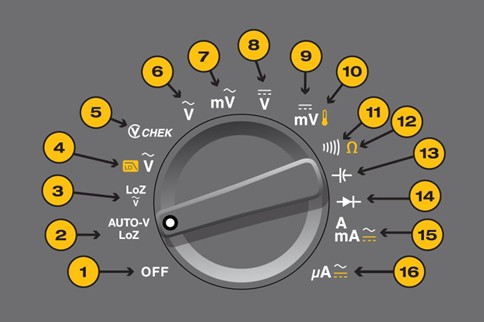
Multimeter Dials
- ON/OFF switch
- AUTO-V/LoZ
- AC voltage/LoZ
- AC voltage with low-pass filter
- VCHEK™
- AC voltage
- AC millivolts
- DC voltage
- DC millivolts
- Temperature
- Continuity
- Resistance
- Capacitance
- Diode test
- AC, DC amps and milliamps
- AC, DC microamps
AC and DC Voltage Measurement using Multimeter
- Always connect the Black probe to the COM port. The Red probe is usually connected to the port with label VΩmA.
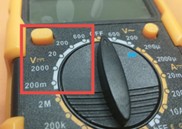
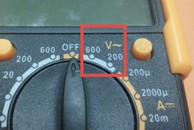
- Set the knob for voltage measurements as shown in figure.
- ⚠️ WARNING: Measure AC Voltage with extreme caution and preferably under a professional supervision.
- Make sure that the probes are properly inserted in to the Multimeter ports without any exposed metal.
- Do not touch the probes by the tips.
- AC Mains can be very dangerous. If in doubt, better not to use Multimeter for AC Mains Voltage measurement.
DC Voltage
AC Voltage
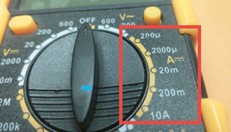
Current Measurement
Most Digital Multimeters can only measure DC Current. So, there will be a straight line adjacent to the A to indicate DC Current measurement.
- Use the other port with label 10ADC to measure DC Current up to 10A.
- The 10A port will usually be marked whether there is an internal fuse or not.
- Be very careful when using this port and do not use this port for long continuous durations (not more than 10s).
We have to make the Multimeter a part of the circuit so that same current passes through the Multimeter as in the component.
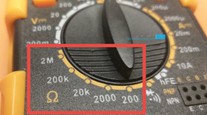
Measuring Resistance
The Ohmmeter section of the Multimeter is represented by Ω symbol. This meter can measure resistance up to 2MΩ.
Measuring Capacitance
- A capacitor can hold charge for several minutes after the power is disconnected, or even longer in rare cases.
- Connect a resistor across the capacitor terminals so the charge can drain safely.
- The multimeter will send out a current to charge the capacitor, measure the resulting voltage, then use the voltage to calculate the capacitance.
- A multimeter in resistance mode can be used to check if a capacitor is faulty or not.
Checks:
- If the displayed values rise from a very low value and progress towards infinity → capacitor works fine.
- Constant very low value → SHORT.
- Constant very high value → OPEN and may be replaced.
Testing Continuity
It is used to test continuity from point A to B in a circuit:
- Whether a wire is conducting or not
- Whether a switch is properly functioning or not
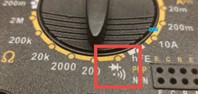
The continuity test function is usually represented by a “speaker” symbol.
Diode Test Analysis
- A good forward-based diode displays a voltage drop ranging from 0.5 to 0.8 V (Silicon).
- Germanium diodes: 0.2 to 0.3 V.
- Multimeter displays OL when a good diode is reverse-biased.
- An open diode: OL in both directions.
- A shorted diode: same reading (~0.4 V) in both directions.
- A multimeter set to the Resistance mode (Ω) can also be used if Diode Test mode is not present.
Measuring hFE (Transistor Gain)
There are three different notations of transistor gain:
- Beta – forward current gain of a transistor.
- hFE – DC or large signal steady-state forward current gain.
- hfe – small-signal current gain (hybrid parameters, forward transfer, common emitter).
The hFE of a transistor is the amplification factor (collector current / base current).
Example datasheets:
- 2N3904 → NPN type, terminal arrangement: E-B-C, hFE = 100(min) – 300(max).
- 2N3906 → PNP type, terminal arrangement: E-B-C, hFE = 100(min) – 300(max).
Insert the right terminal to the right socket and transistor type:
- B terminal → B socket
- C terminal → C socket
- E terminal → E socket
In case of a bad transistor: shorted or opened will be displayed.
```python def foo(): pass