Experiment 4: Superposition Theorem
Aim
Verification of Superposition Theorem
Components and Equipment Required
- DC voltage source
- Resistors
- Ammeter
- Connecting wires
- Breadboard
Theory
The superposition principle states that the voltage across (or current through) an element in a linear circuit is the algebraic sum of the voltages across (or currents through) that element due to each independent source acting alone.
In simpler terms, it allows you to determine individual currents or voltages for each source acting alone, and then combine them to get the total solution.
Procedure
- Make the connections as per the diagram.
- Set particular voltage values V1 and V2, and note the ammeter reading (Figure 1).
- Set the same voltage using V1 alone, short-circuit the other terminals, and note the ammeter reading (Figure 2).
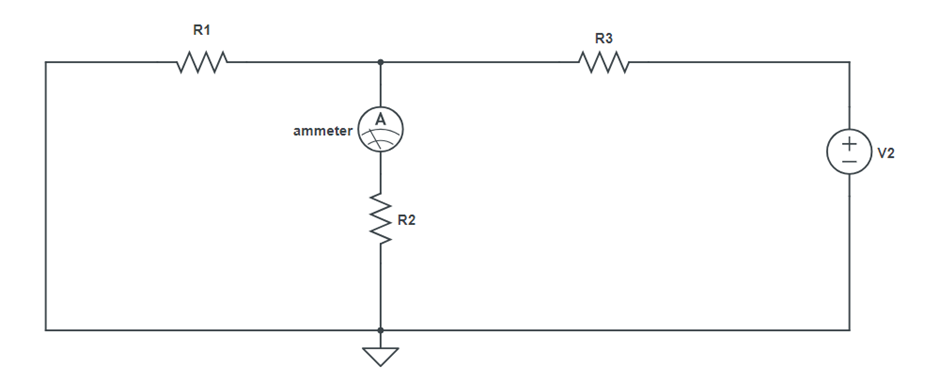
- Set the same voltage using V2 alone, and note the ammeter reading (Figure 3).
- Verify the Superposition Theorem by comparing the results.
Figures
Figure 1: Circuit with both V1 and V2 connected

Figure 2: Circuit with V1 connected and V2 shorted
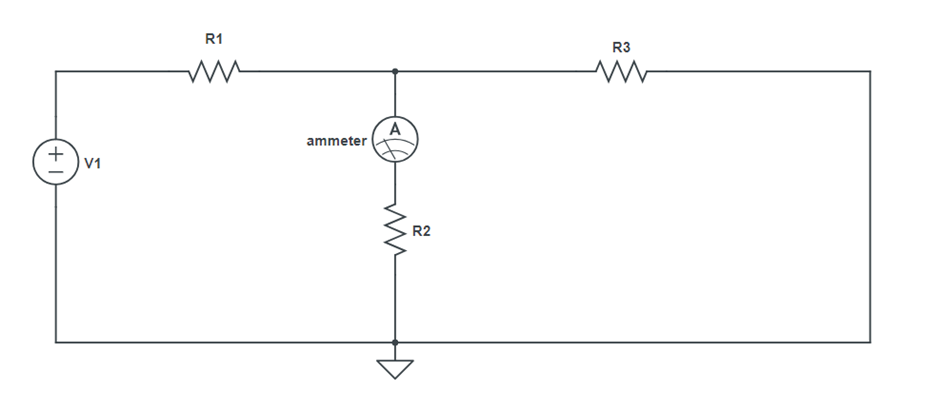
Figure 3: Circuit with V2 connected and V1 shorted
Observation Table
| Condition | Current Obtained | Theoretical Values | Practical Values |
|---|---|---|---|
| V1, V2 both connected | |||
| V1 connected | |||
| V2 connected |
Result
Thus, the Superposition Theorem is verified.
Precautions
- Keep the voltage control knob at minimum initially.
- Ensure that the power supply and ammeter are working properly.