Hall Effect
AIM
- To determine the Hall voltage developed across the sample material.
- To calculate the Hall coefficient and the carrier concentration of the sample material.
APPARATUS
- Two solenoids
- Constant current supply
- Four probe
- Digital gauss meter
- Hall effect apparatus (consisting of Constant Current Generator (CCG), digital milli voltmeter, and Hall probe)
THEORY
If a current-carrying conductor is placed in a perpendicular magnetic field, a potential difference will generate in the conductor which is perpendicular to both magnetic field and current. This phenomenon is called Hall Effect. In solid-state physics, Hall effect is an important tool to characterize the materials, especially semiconductors.
FORMULA
$$ V_H = Ew = vBw = \frac{IB}{net} $$
Where:
- $V_H$ = Hall voltage
- $I$ = Current through the sample
- $B$ = Magnetic field
- $n$ = Carrier concentration
- $e$ = Charge of electron
- $t$ = Thickness of the sample
- $R_H$ = Hall coefficient
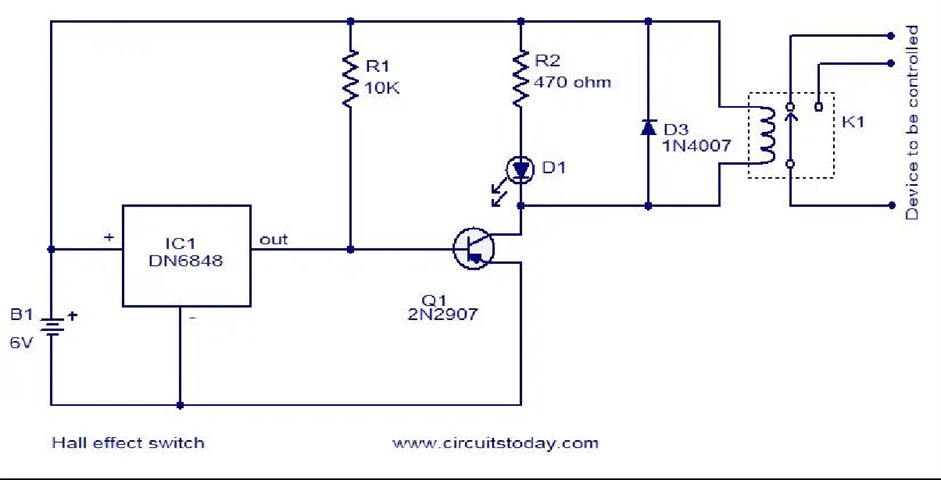
CIRCUIT DIAGRAM
OBSERVATION TABLE
| S.No. | Magnetic Field (B) | Thickness (t) | Hall Current (I) | Hall Voltage (VH) | RH |
|---|---|---|---|---|---|
| 1 | |||||
| 2 | |||||
| 3 | |||||
| 4 | |||||
| 5 |
PROCEDURE
- Connect the constant current source to the solenoids.
- Connect the four probe to the Gauss meter and place it at the middle of the two solenoids.
- Switch ON the Gauss meter and constant current source.
- Vary the current through the solenoid from 1A to 5A with the interval of 0.5A, and note the corresponding Gauss meter readings.
- Switch OFF the Gauss meter and constant current source and turn the knob of the constant current source towards minimum current.
- Fix the Hall probe on a wooden stand. Connect green wires to Constant Current Generator (CCG) and connect red wires to the milli voltmeter in the Hall Effect apparatus.
- Replace the four probe with Hall probe and place the sample material at the middle of the two solenoids.
- Switch ON the constant current source and CCG.
- Carefully increase the current $I$ from CCG and measure the corresponding Hall voltage $V_H$. Repeat this step for different magnetic field $B$.
- Measure the thickness $t$ of the sample using a screw gauge.
- Calculate the Hall coefficient $R_H$.
- Calculate the carrier concentration $n$.
PRECAUTIONS
- Hall voltage should be measured very carefully and accurately.
- The current through the probe should not exceed a certain minimum value.
- The digital voltmeter should be handled carefully.
- The distance between pole pieces of the electromagnet should not be changed during the whole experiment.
RESULT
- Hall coefficient of the material =
- Carrier concentration of the material =