Experiment 1
Aim
Study of op-amp characteristics: CMRR and Slew Rate.
Apparatus Required
741 IC
Multimeter
CRO
Dual power supply (15-0-15 V)
Connecting wires
Theory
CMRR
CMRR stands for Common Mode Rejection Ratio. It measures the ability of an operational amplifier to reject common-mode signals, which are signals that appear simultaneously on both the inverting and non-inverting inputs.
Ideally, an op-amp should have infinite CMRR, meaning it should reject all common-mode signals perfectly. However, in practical terms, CMRR is finite.
CMRR is defined as the ratio of differential gain to common-mode gain:
$CMRR = \frac{A_d}{A_c}$
In decibels,
$CMRR(dB) = 20 \log \left(\frac{A_d}{A_c}\right)$
For the IC 741 op-amp, the typical theoretical value of CMRR can be around 90 dB to 100 dB, but the practical value might vary based on manufacturing tolerances and environmental conditions.
Slew Rate
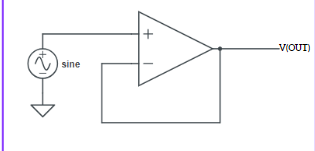
Slew rate refers to the maximum rate of change of the output voltage per unit of time. It determines how fast an op-amp can respond to changes in the input signal.
Ideally, an op-amp should have infinite slew rate, meaning it can respond instantaneously to changes in the input signal. However, in reality, op-amps have finite slew rates.
Slew rate is defined as:
$SR = \frac{dV_o}{dt}$
For the IC 741 op-amp, the typical theoretical value of slew rate is around 0.5 V/µs, but the practical value might be slightly lower due to various factors such as load conditions and temperature.
Circuit Diagram
CMRR

Slew Rate
Precautions
- Do not connect more than 15 V DC supply.
- Always check the dual power supply with a multimeter before connecting it to the circuit.
- Connect an input supply such that the corresponding output remains within the range +14 to -14 volts.
- Connections should be neat and tight.