MOSFET
Aim
To study the V-I characteristics of MOSFET.
Apparatus Required
- MOSFET
- Bread board
- Resistor
- Two Voltage Sources
- Connecting Wires
Theory
MOSFET stands for Metal Oxide Semiconductor Field Effect Transistor. It is a four-terminal device whose substrate terminal must always be held at one of the extreme voltages in the circuit—either the most positive for PMOS or the most negative for NMOS.
One unique property of MOSFET is that the gate draws no measurable current. The body of any N-channel MOSFET is made up of P-type material. Two N-type materials are diffused at the top, forming a depletion region in the PN junction. A metal contact is made at the bottom of the P-type substrate and a terminal is taken out called the body or substrate.
Similarly, a metal contact is made at the top of both N-type materials, and two terminals are taken out as Drain and Source. A silicon dioxide layer is placed between the two N-type wells at the top, and a metal contact is taken out as the Gate terminal.
MOSFET is used in:
- High-frequency amplifiers
- Brushless DC motor drives
- Electronic DC relays
- Inverters
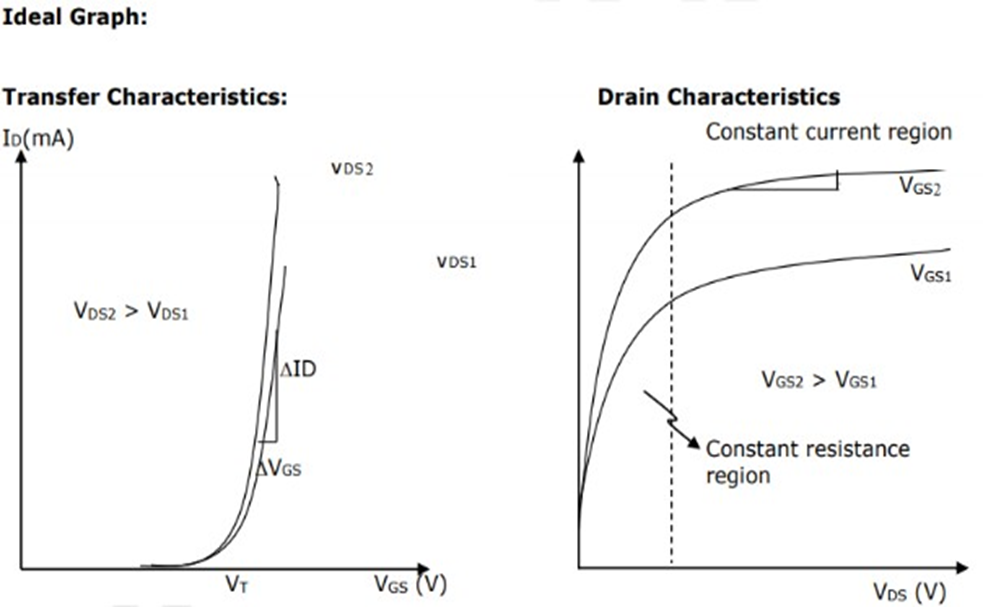
The voltage at which the channel of the MOSFET closes is called the pinch-off voltage. When $V_{DS}$ is increased beyond the pinch-off voltage, $V_{GS}$ controls the channel current and $V_{DS}$ has little or no effect; it remains constant.
Circuit Diagram

Output/Drain and Transfer Characteristics:
Procedure
Output/Drain Characteristics
- Connect the circuit as per the diagram properly.
- Keep $V_{GS}$ constant at a chosen value by varying $V_{GG}$.
- Vary $V_{DS}$ and measure the drain current $I_D$. Tabulate all readings.
- Repeat the procedure for different values of $V_{GS}$.
Transfer Characteristics
- Connect the circuit as per the diagram properly.
- Set the voltage $V_{DS}$ constant at a particular value.
- Vary $V_{GS}$ by varying $V_{GG}$ and note the value of drain current $I_D$. Tabulate all readings.
- Plot the Output Characteristics ($V_{DS}$ vs $I_D$) and Transfer Characteristics ($V_{GS}$ vs $I_D$).
Observation
Output/Drain Characteristics
| VGS = | VGS = | VGS = | VGS = | VGS = | |||||
|---|---|---|---|---|---|---|---|---|---|
| VDS(V) | ID(mA) | VDS(V) | ID(mA) | VDS(V) | ID(mA) | VDS(V) | ID(mA) | VDS(V) | ID(mA) |
Transfer Characteristics
| VDS = | |
|---|---|
| VGS (V) | ID (mA) |
Result
Hence, when we apply and vary $V_{DS}$ at constant $V_{GS}$, the drain current $I_D$ increases and after some time it becomes constant.
Precautions
- The reading should be in multiples of the least count.
- For accuracy, current should be measured in mA.