Inductor
The Inductor, also called a choke, is another passive type electrical component designed to take advantage of the principle that a current-carrying coil has a magnetic flux developed across it, whose magnitude is directly proportional to the amount of current (direction given by Fleming’s Left Hand rule).
It induces a voltage into the coil to oppose any change in the electrical current flowing through it. So, in an inductor, the magnetic field reacts to oppose any change in the current.
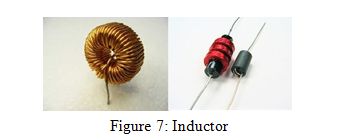
Types of Inductors
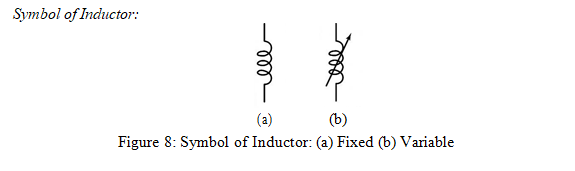
All the inductors are categorised into fixed and variable, used for different applications.
- Filter chokes → used in smoothing the pulsating current.
- Depending on the frequency range:
- Audio-frequency chokes (AFC)
- Radio-frequency chokes (RFC)
Fixed Inductors
- Air inductors
- Iron-core inductors
- Ferrite core inductors
Variable Inductors
- Similar to fixed ferrite core inductors
- Core is adjustable → can be slid in or out of the coil
Inductance
The reaction of magnetic field trying to make the current steady is known as inductance, and the force which it develops is called induced emf.
- Definition: Inductance is the measure of energy stored in the coil in the form of a magnetic field and has the ability to produce induced voltage whenever current varies through it.
- Unit: Henry ($H$)
Inductance Value
- Inductors come in many different sizes.
- Larger inductors → specifications written on the package.
- Moderate to smaller inductors → use numerical colour codes.
- Besides inductance value, tolerance is also an important specification marked on most packages.
- Most inductors have inductance in the micro-Henry $(µH)$ or milli-Henry $(mH)$ range.